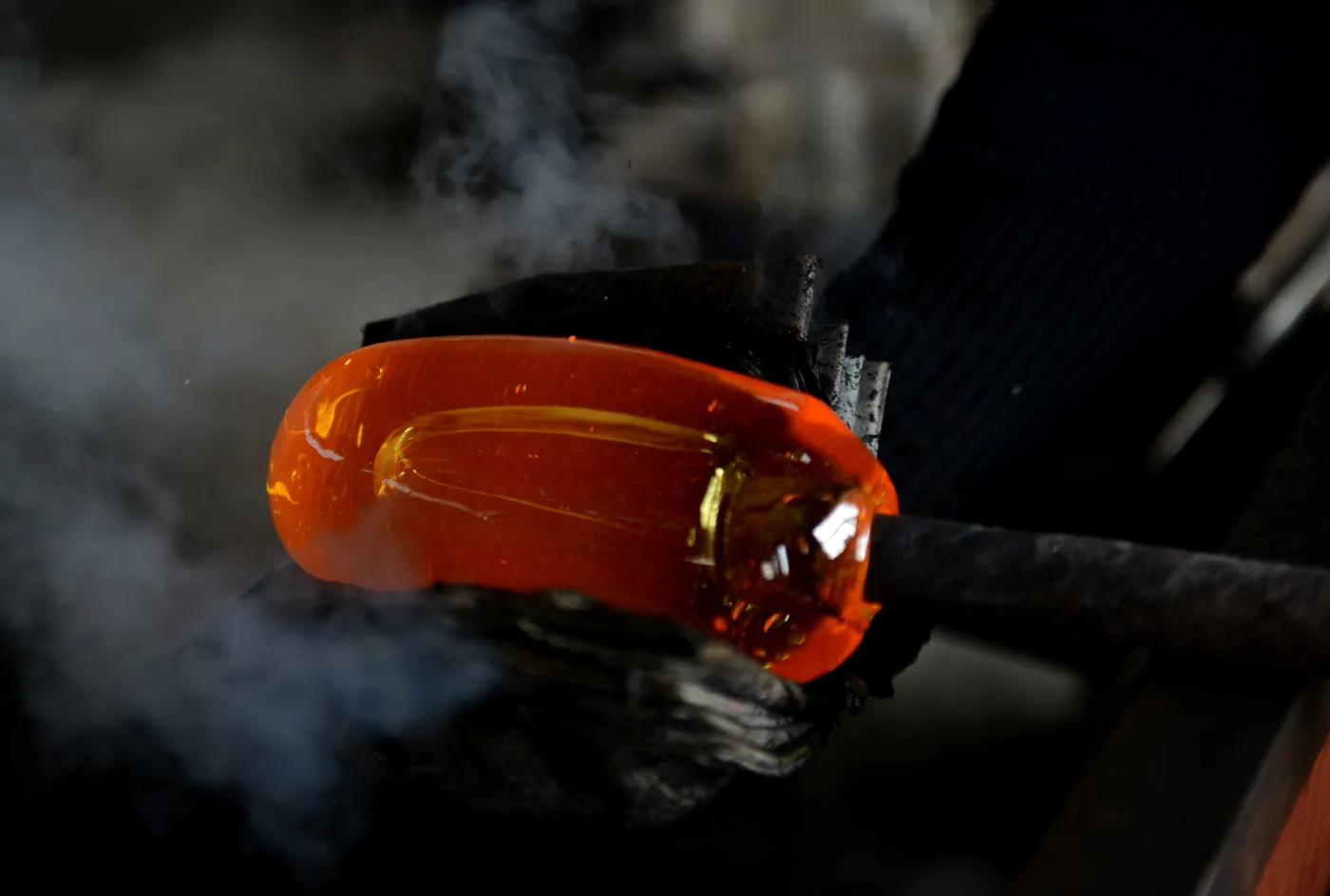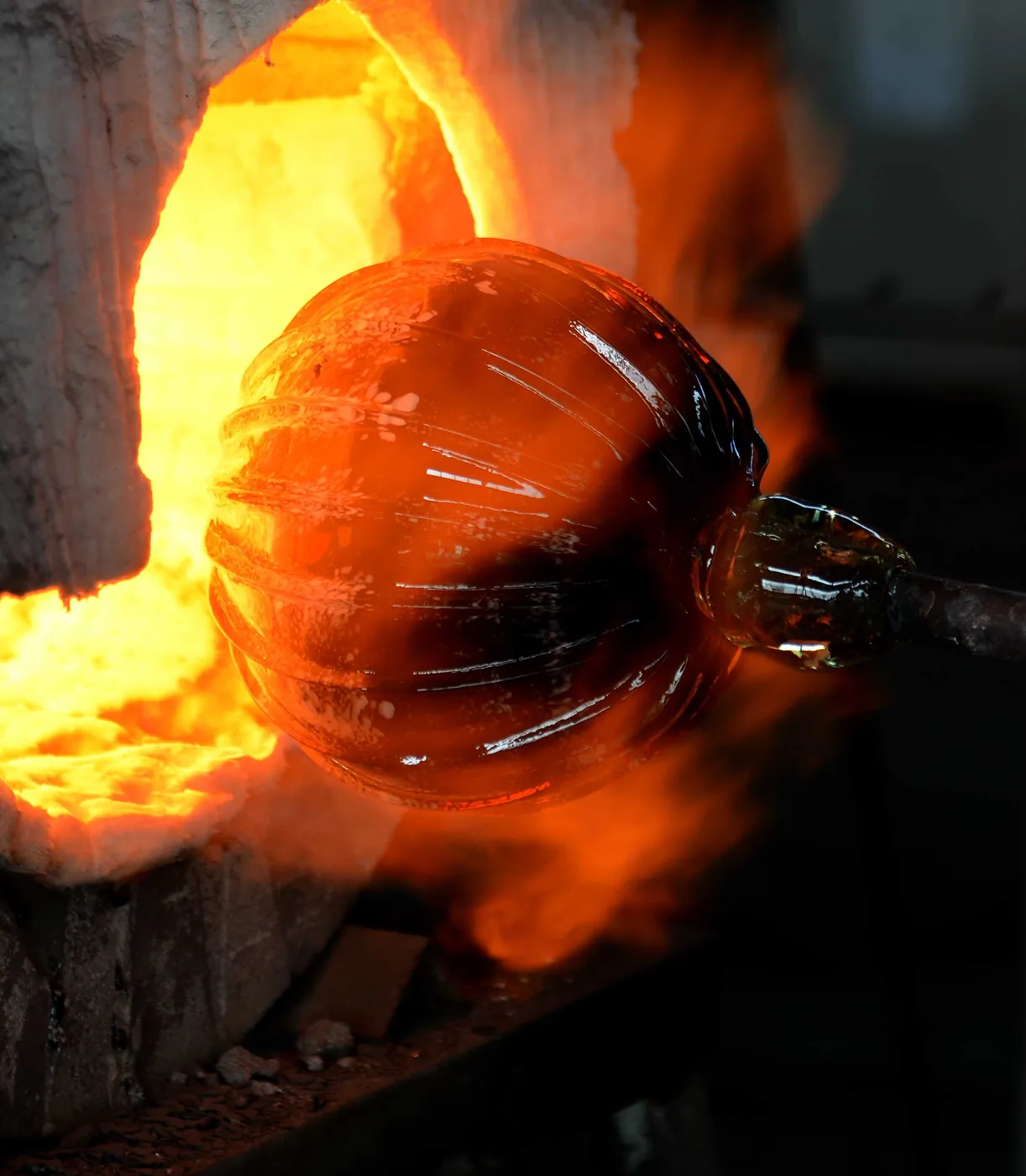
A texture either comes from a mold or is made by hand, and that decides how closely it repeats. On our shades, molded textures such as dimples or a pebbled surface repeat from piece to piece, while hand-made ones such as trapped bubbles or wrapped threads vary slightly; the approved sample sets the range (SIGA, 2026). Choose by how alike the pieces must be.
Hammered glass has a surface of shallow irregular dents, like light on rippled water.
Dimpled glass has raised or sunken round bumps in a regular pattern.
Thread-wrapped glass has thin strands of glass wound around the body while it is hot.
Textured clear glass softens the bulb without hiding it and adds sparkle when the lamp is on, which suits pendants over bars, counters and tables. This guide covers the textures beyond ribs and flutes, which have their own guide, and shows where each one sits between the two processes we use.
Which textures come from a mold?
Regular patterns. A mold carries the pattern in its inner surface, and in mold blowing the glass is forced against those surfaces and takes the shape and the decoration (Corning Museum of Glass). Our clear dimpled ball, with raised dimples in staggered rows, and our clear pebbled egg, with a fine ice-like surface, are both molded. The Corning Museum of Glass separates this from a dip mold, which only imparts a pattern before the glass is blown and tooled; a full-size mold gives the final form (Corning Museum of Glass).
On a molded shade, the pattern repeats from piece to piece, and diameter and height hold a total error of 1 to 2 mm (SIGA workshop estimate, 2026). That makes a molded texture the choice for a long row of pendants that must look the same.
Which textures are made by hand?
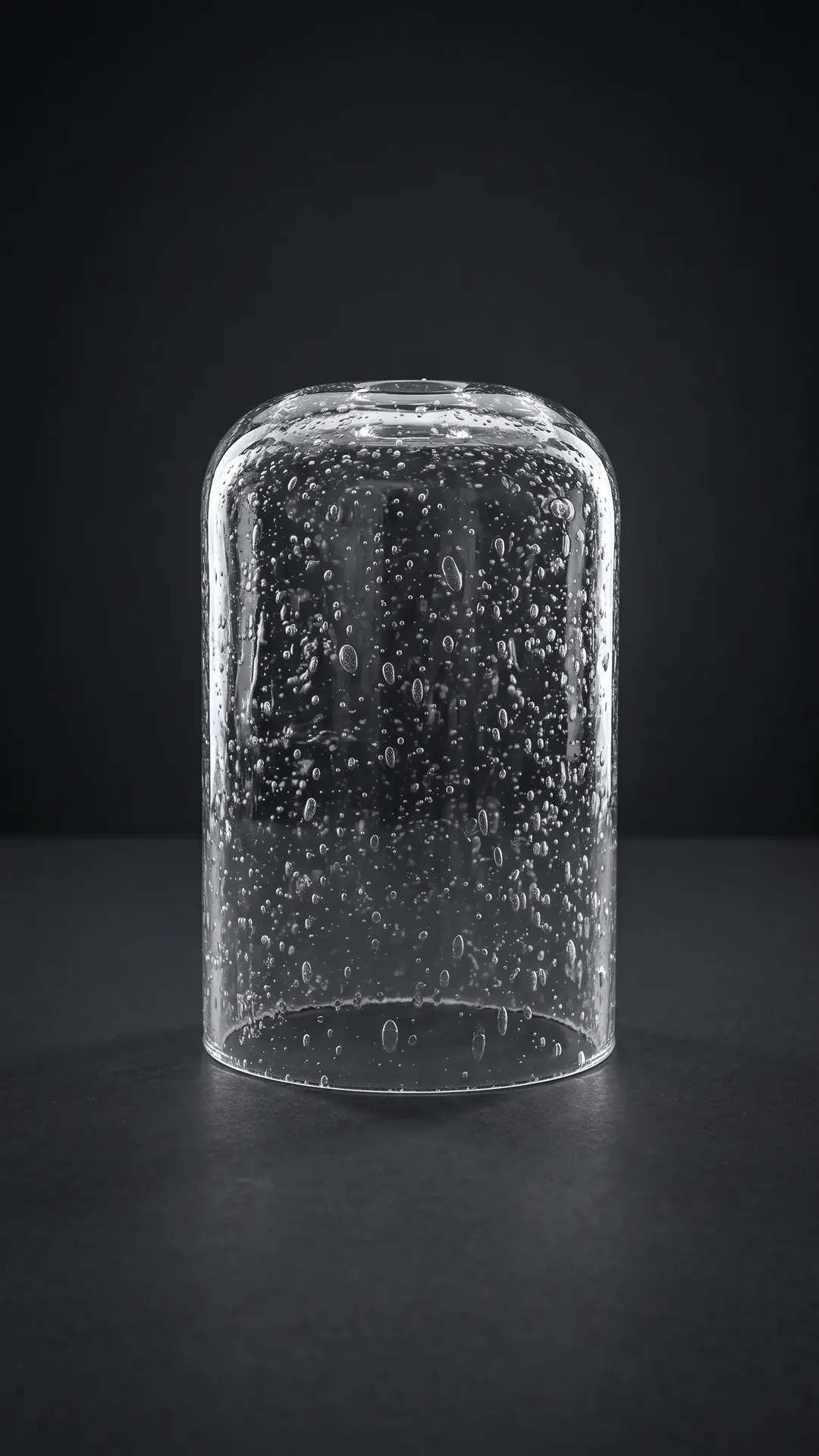
Effects added while the blower works the glass. Our fully hand-blown shades can carry wrapped threads, layered color, swirls and gradients (SIGA, 2026). Our clear thread-wrapped cylinder has irregular threads wound around a clear body, and our clear bubble cylinder has small air bubbles trapped in its thick walls on purpose. Our glass pendant light shades page shows textured and plain pendants together.
Hand-made textures never repeat exactly. Each hand-blown piece differs slightly and has thicker walls than a molded one (SIGA, 2026), so the approved sample is the reference for how dense or how coarse the texture may be.
Where does a hammered texture sit?
Between the two. Our clear hammered oval is fully hand-blown, so the scale of its texture differs slightly from piece to piece and is agreed on the sample. If the texture must repeat closely, ask about a molded version instead: any shape can be made in a mold (SIGA, 2026), and a mold repeats what it carries.
| Texture | Example in our catalog | Process | Across an order |
|---|---|---|---|
| Dimpled | Clear dimpled ball | Mold | Repeats |
| Pebbled | Clear pebbled egg | Mold | Repeats |
| Hammered | Clear hammered oval | Fully hand-blown | Varies slightly |
| Trapped bubbles | Clear bubble cylinder | Fully hand-blown | Varies slightly |
| Wrapped threads | Clear thread-wrapped cylinder | Fully hand-blown | Varies slightly |
Are bubbles in a textured shade a defect?
Not when they are the design. Small bubbles are a natural feature of hand-blown glass, and we accept them when they do not affect use or look; large or burst bubbles count as defects (SIGA, 2026). On a bubble-texture shade, write the density you want on the order, so the inspection and the sample use the same reference. The inspection guide explains how to agree that in writing.
How do I specify a texture?
Name the texture and how coarse or dense it should be, and say whether every piece must match. If it must, ask for a molded texture; if small differences are welcome, a hand-made texture is open to you, with no mold fee. Add the shape, the three size numbers and the opening, as in our specification guide, and confirm the texture on the sample: we send photos or a video first (SIGA, 2026).
When is a textured shade the wrong choice?
A heavily textured shade is a poor fit when the client needs a perfectly even glow or wants the bulb fully hidden, since clear textured glass softens the bulb rather than hiding it; frosted or opal glass does that better. A hand-made texture is also the wrong choice for a row that must look identical. We are not the right supplier for orders with excessively strict requirements (SIGA, 2026).
Sources and Further Reading
- Corning Museum of Glass: Mold Blowing. Explains that glass blown into a mold takes its shape and any decoration it bears. Checked 2026-10-18.
- Corning Museum of Glass: Molds and Moldmaking. Separates dip molds that impart a pattern from full-size molds that give the final form. Checked 2026-10-18.
Frequently Asked Questions
Which glass texture repeats best across a large order?
A molded one. On our shades, a mold repeats the pattern from piece to piece, and diameter and height hold a total error of 1 to 2 mm (SIGA workshop estimate, 2026). Hand-made textures such as threads or trapped bubbles vary slightly, within the range shown on the approved sample.
Does a textured shade hide the bulb?
It softens it. Clear textured glass scatters the light into sparkle but leaves the bulb visible, so choose the bulb together with the shade. If the bulb must be hidden, frosted or opal glass is the better route.
Can a textured shade be colored?
Yes. Fully hand-blown shades come in 14 standard colors, with others on request, while molded shades are mainly clear and white, with other colors added after forming by plating or color spraying (SIGA, 2026). The quote states how the color is made.
Have a texture in mind? Send a photo and your shape, and we tell you whether it suits a mold or hand-blowing.
Ask about your design