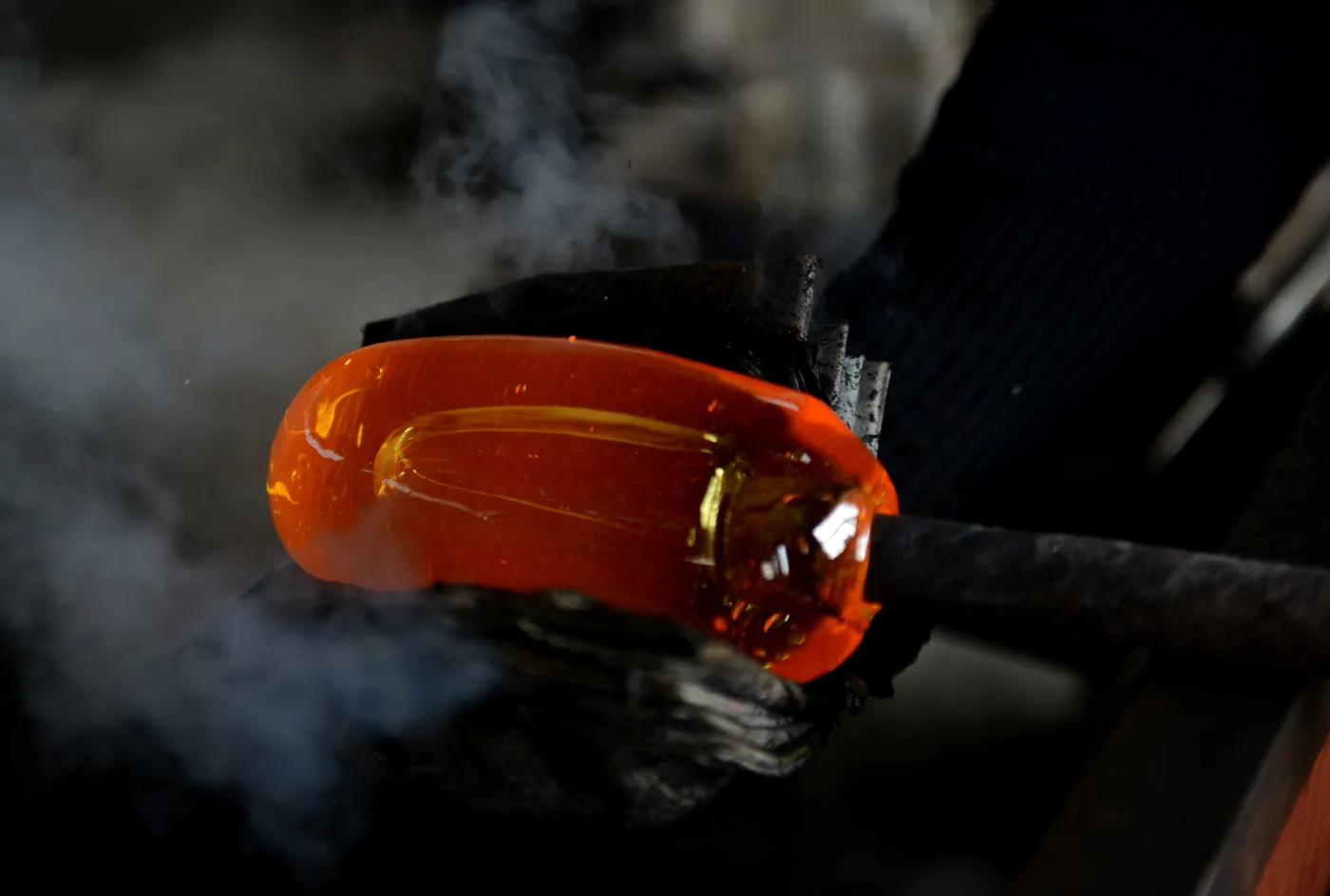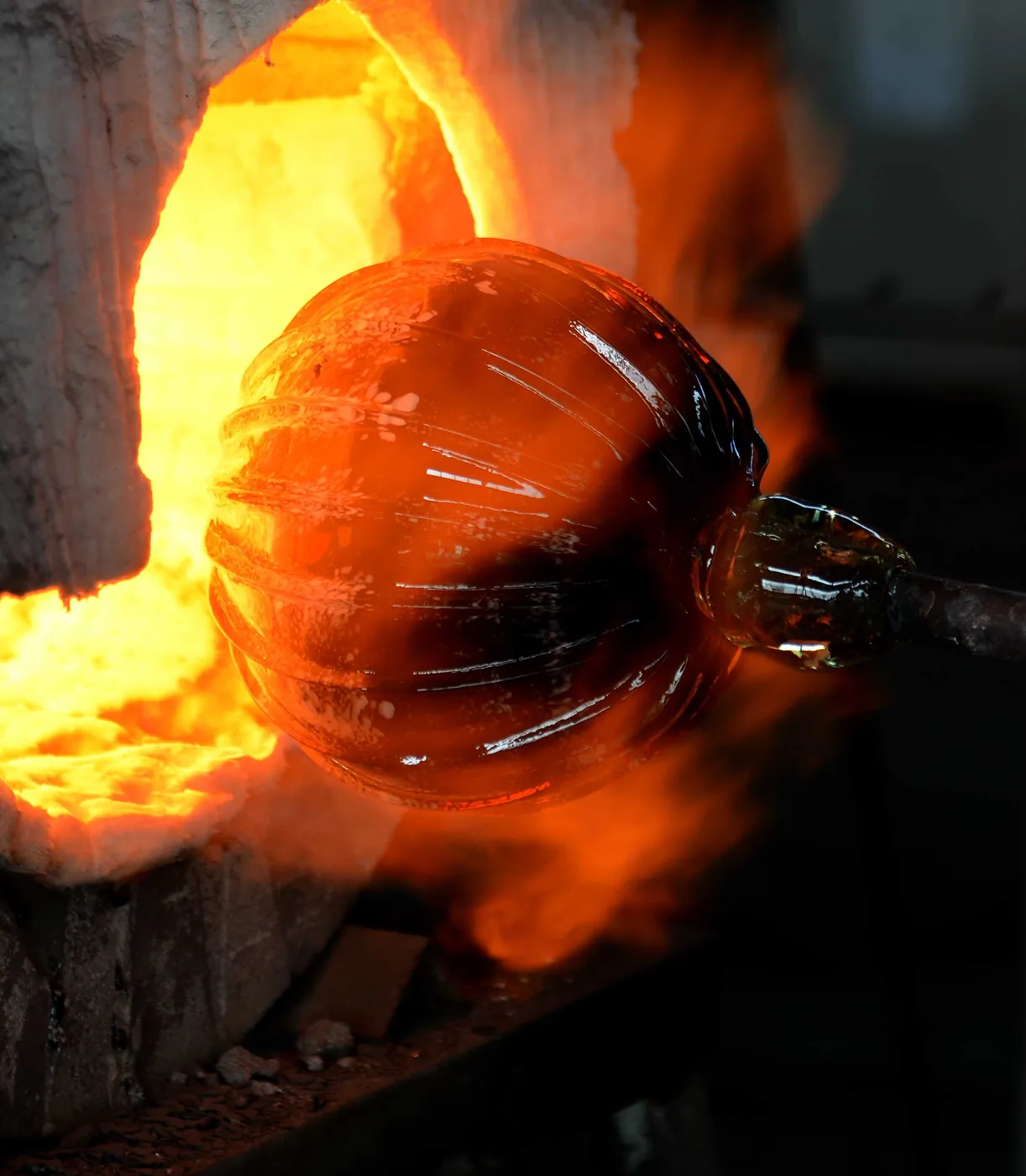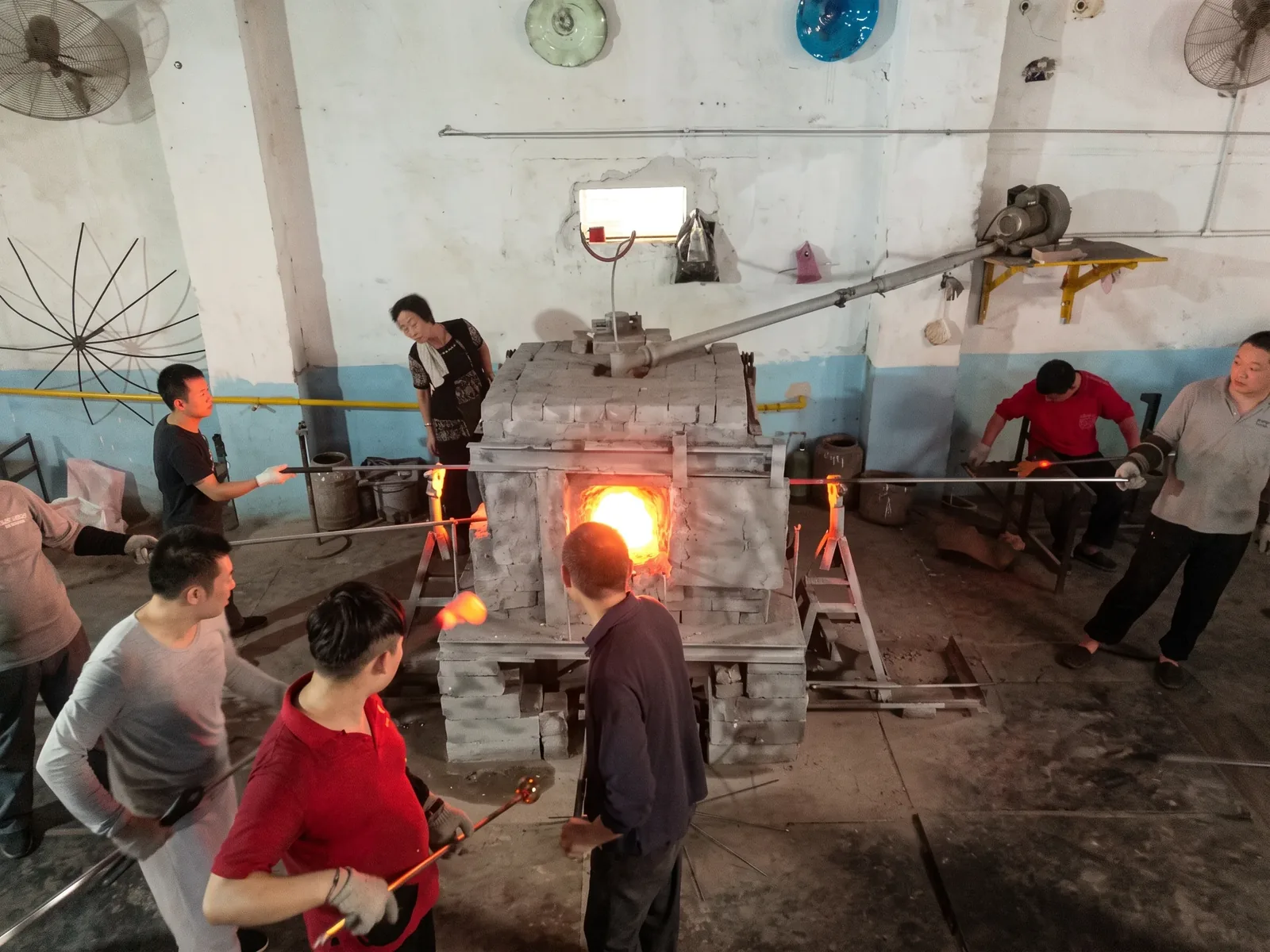
We blow two ambers by hand, light amber and deep amber, both in our standard range of 14 colors. Choose light amber when the shade must still give useful light, and deep amber when the glass itself is the feature. Molded shades are mainly clear or white, with other colors added after forming by plating or color spraying (SIGA, 2026).
Amber glass is glass colored yellow-brown in the melt, most commonly by combining iron, sulfur and carbon (Glass Packaging Institute).
Body color is color that runs through the glass itself, as opposed to a coating, plating or spray applied to the surface after forming.
Choosing amber for a pendant shade raises three practical questions: which amber, how much light it lets through, and whether a whole order will match. This guide answers them for the shades we make in Zibo, China. Our guide to clear, tinted and milk glass covers the wider choice of glass.
What makes glass amber?
Amber is usually a color made in the melt. The Glass Packaging Institute describes amber as the most common colored glass and says it is produced by combining iron, sulfur and carbon (Glass Packaging Institute). In a lecture on commercial glass color, James E. Shelby attributes the color to an iron-sulfur chromophore and notes that several models of how it absorbs light have been proposed (James E. Shelby, Lehigh IMI).
The chemistry is still studied. A 2018 experiment on ancient amber glass concluded that the cause of the color is complex and can be attributed to the iron-sulfur chromophore (Paynter and Jackson, University of Sheffield). For a buyer, the practical point is simpler: when amber is made in the melt, the color is part of the glass and the approved sample shows the result.
Light amber or deep amber: which should I choose?
Choose by the job the shade has to do. Light amber tends to give a warm cast while still passing more of the light, which suits a shade that also has to light a table or a counter. Deep amber reads as a strong, rich color and lets less light through, so it suits accent and decorative pendants where the glass is the point.
The reason is the same for any tinted glass. In colored glass, absorbance rises with the thickness the light travels through, as the Beer-Lambert law states (James E. Shelby, Lehigh IMI), and a deeper tint absorbs more at the same thickness. We do not publish light transmission figures for our glass, so judge the two ambers on a sample with the bulb you plan to use.
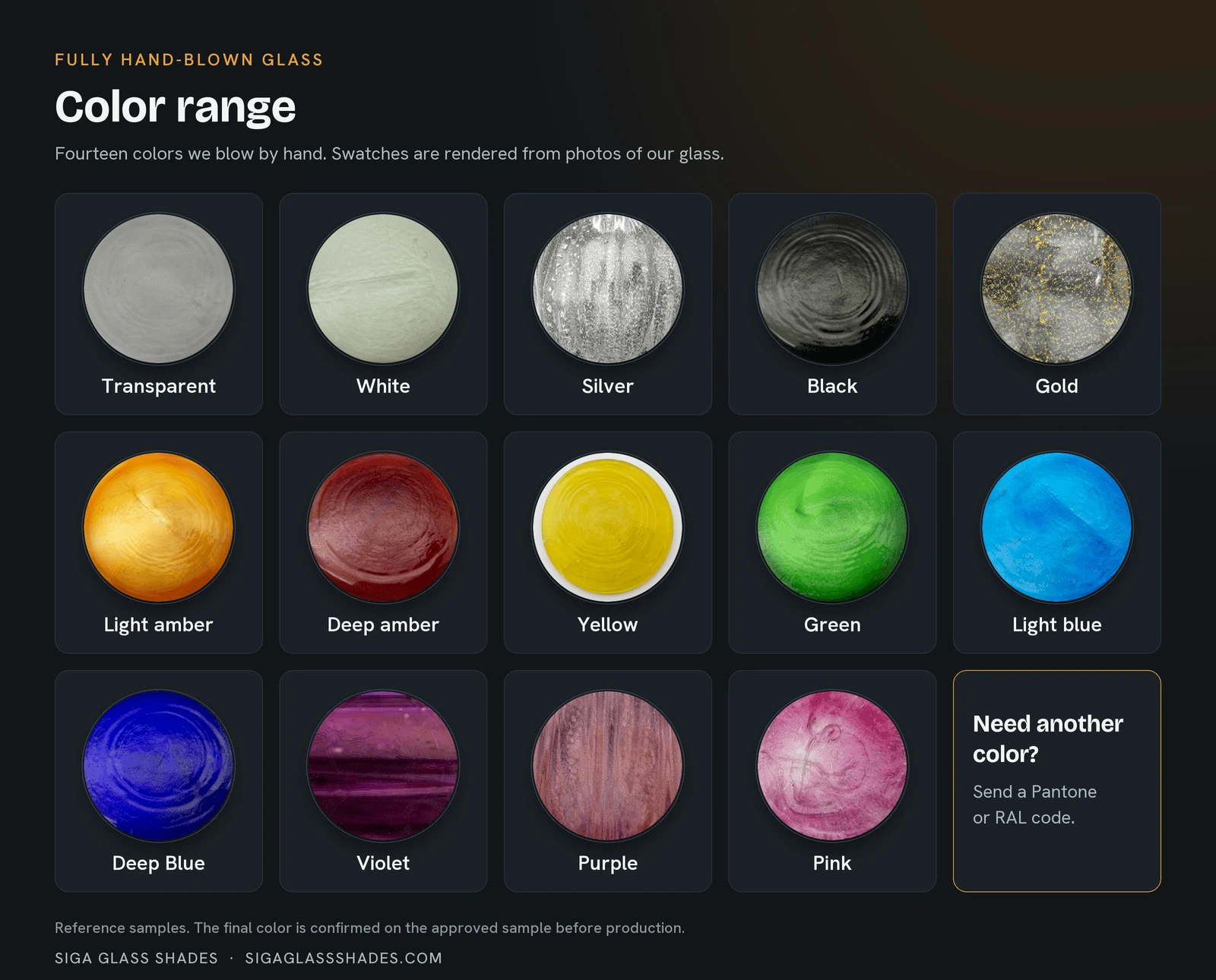
| Light amber | Deep amber | |
|---|---|---|
| Look | Warm, pale honey | Rich, dark |
| Light through the glass | More | Less |
| Suits | Shades that also light a table or counter | Accent and decorative pendants |
Can a molded shade be amber?
Yes, with a different method. Our semi hand-blown shades, which are blown into molds, are mainly made in transparent and white glass, and other colors are added after forming by plating or color spraying. Whether a color is in the glass or on the surface varies by design, and the quote states which (SIGA, 2026).
That choice changes how the shade looks, so ask for it in writing. If a body-colored amber matters more than mold-level repeatability, a fully hand-blown shade is the route. Our glass pendant light shades page compares the two processes for pendants.
Will every amber shade in an order match?
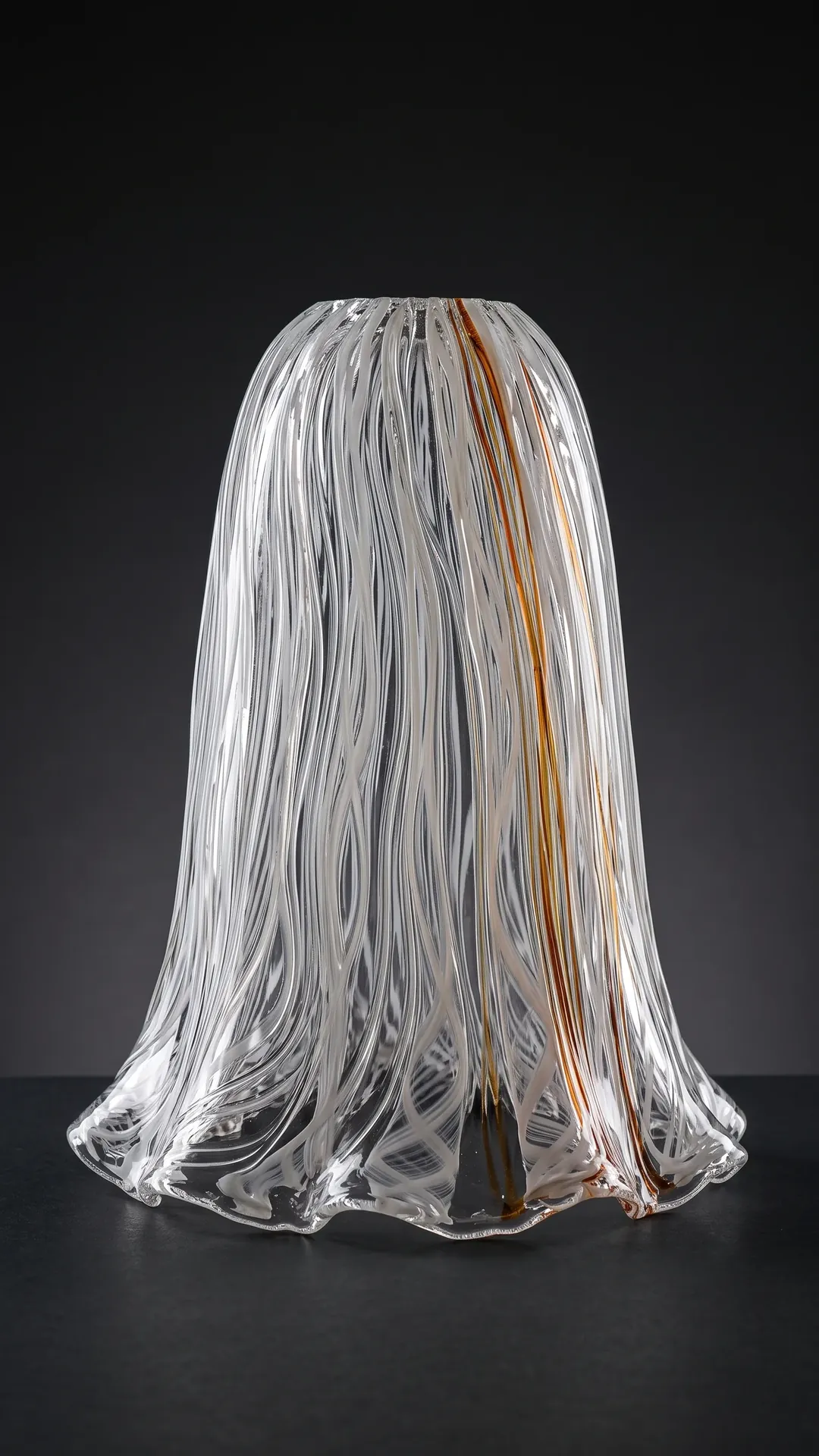
Closely, not exactly. Each hand-blown piece differs slightly and has thicker walls than a molded one (SIGA, 2026), and where the wall is thicker, the amber tends to look deeper. The approved sample is the reference for the batch, and a shade like our clear frilled jellyfish, shows amber used as stripes in clear glass.
How do I specify an amber shade?
Name the amber from our color range, or send a Pantone or RAL code, which we match on request (SIGA, 2026). A photo or a reference shade helps show the look you want. RAL is a color standard body that defines shades rather than making paint, and its RAL CLASSIC collection holds 216 shades (RAL).
Say whether the color will be judged with the lamp on or off, because color reads differently with the bulb on. Then confirm it on the sample: we send photos or a video first, and ship a physical sample on request, with shipping paid by the buyer (SIGA, 2026). The sample page sets out the steps.
When is amber not the right choice?
Amber is a poor fit for a shade that must give bright, neutral task light, since it warms and dims the light that passes through. Deep amber is a poor fit when many shades in a row must match in tone, because body color can shift with wall thickness on hand-blown pieces. In that case a paler tint may hold its tone better, since it absorbs less; that is our reading of the Beer-Lambert law, not a measured result, so compare samples. A clear shade in a mold with a warm bulb is another route. We are not the right supplier for orders with excessively strict requirements (SIGA, 2026).
Sources and Further Reading
- Glass Packaging Institute: Glass Color Chemistry. States that amber, the most common colored glass, is produced by combining iron, sulfur and carbon. Checked 2026-10-18.
- James E. Shelby, Color in Commercial Glasses (Lehigh University IMI glass course, lecture 4). Attributes amber to an iron-sulfur chromophore and states the Beer-Lambert law. Checked 2026-10-18.
- Paynter and Jackson (2018), Mellow yellow: an experiment in amber, Journal of Archaeological Science: Reports. An experimental study attributing the amber color to the iron sulphur chromophore. Checked 2026-10-18.
- RAL: Frequently asked questions. Gives the number of RAL colors and explains that RAL defines and standardizes shades. Checked 2026-10-18.
Frequently Asked Questions
Is amber color in the glass or painted on?
It depends on the design. Light amber and deep amber are in our standard range for fully hand-blown shades, and on molded shades other colors are added after forming by plating or color spraying (SIGA, 2026). The quote states whether the color is in the glass or on the surface, so you know before the sample is made.
Does amber glass reduce the light from the bulb?
Yes. Tinted glass absorbs part of the light, and a deeper tint or a thicker wall absorbs more, as the Beer-Lambert law describes (Shelby, Lehigh IMI). We do not publish transmission figures, so compare light and deep amber on a sample with the bulb you plan to use.
How do I give you an amber to match?
Send a Pantone or RAL code, and we match it on the sample (SIGA, 2026). A photo or a reference shade helps show the look. Tell us whether the reference should be judged lit or unlit, since color reads differently with the lamp on, and approve the sample before production starts.
Choosing between light and deep amber? Ask for a sample in both and judge them with your own bulb.
Request a sample