Choose a mold if every piece must match in shape and size: shades from our molds hold a total error of 1 to 2 mm on diameter and height, while fully hand-blown shades vary by about 5 mm in total (SIGA workshop estimate, 2026). Choose fully hand-blown if you accept that each piece differs slightly and you want to avoid the mold fee. Both start at 20 pieces per design.
- Any shape can be made in a mold, so the real question is whether you need every piece to match (SIGA, 2026).
- Molded shades hold a total error of 1 to 2 mm and hand-blown shades about 5 mm, measured on diameter and height (SIGA workshop estimate, 2026).
- A mold is a one-time fee, separate from the unit price, and the cost guide sets out the range (SIGA terms, 2026).
- Hand-blown shades have thicker walls and look less uniform, so you judge them from the sample you approve before bulk production starts (SIGA, 2026).
Fully hand-blown glass is shaped freehand by a glassblower, without a mold (Wikipedia).
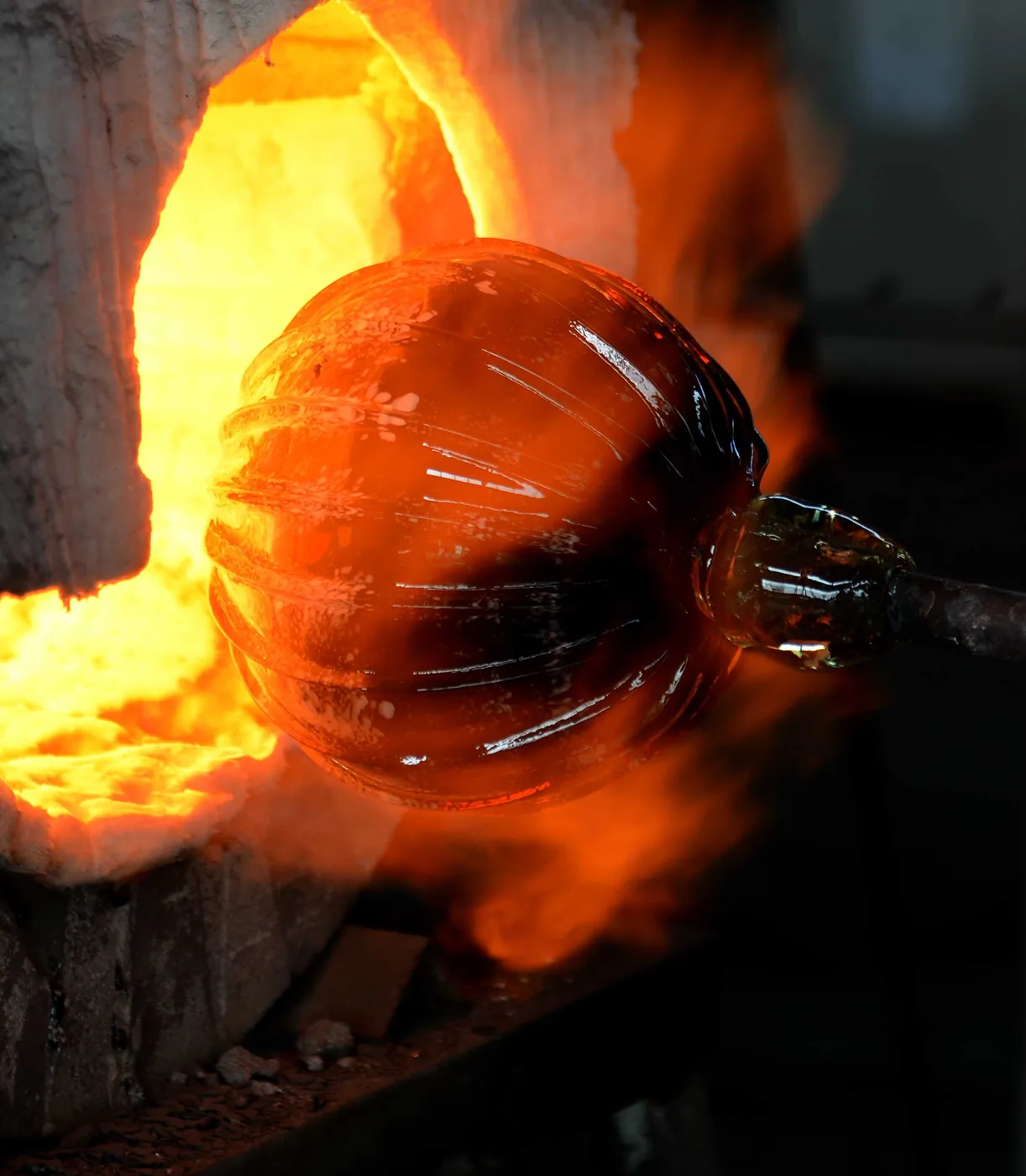
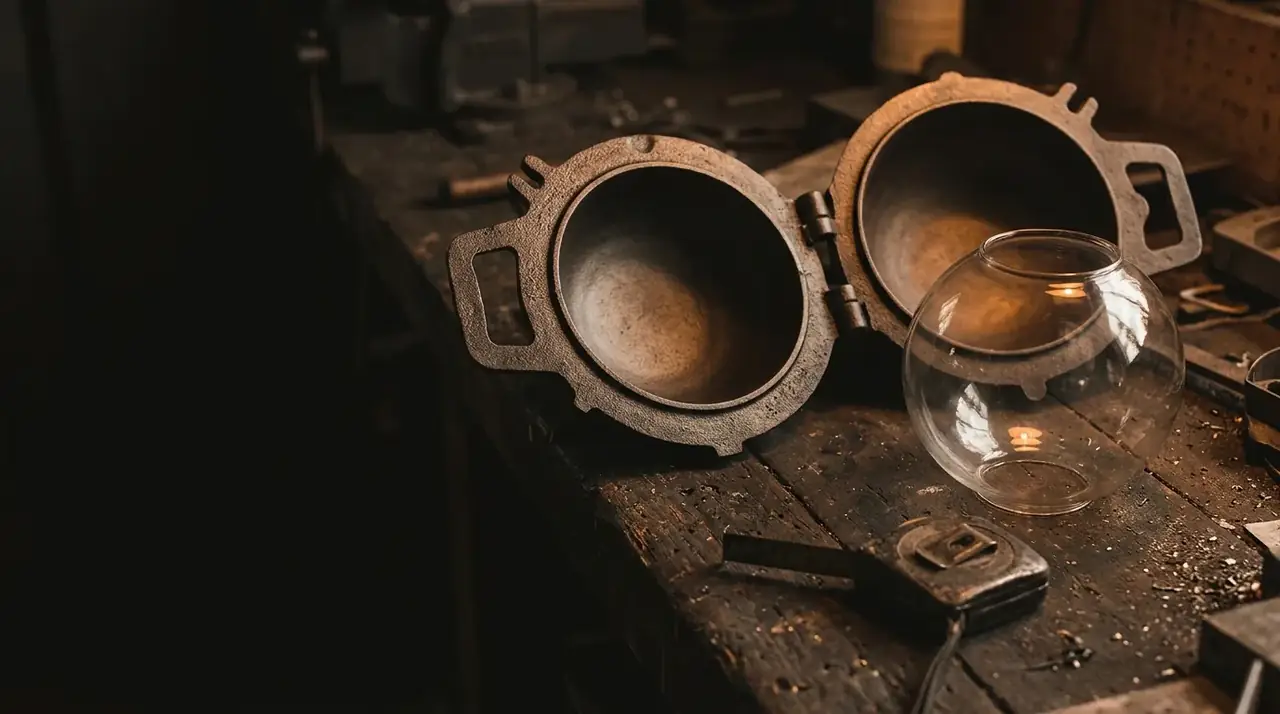
Mold-blown (semi hand-blown) glass is glass that a worker blows into a mold, which gives the piece its shape (Corning Museum of Glass).
Total error is the full difference between the largest and the smallest measurement, not a plus or minus figure.
SIGA Glass makes both kinds in Zibo, China, so we can compare them without a preference for either (SIGA, 2026). Buyers usually ask the same thing first: which one should I order? This guide sets the two side by side, then gives the rule we use when we advise a buyer.
How do hand-blown and mold-blown shades compare?
They differ most in consistency, wall thickness and cost structure. A mold fixes the shape, so every piece repeats it. Hand-blown shades are shaped by the blower, so each piece differs slightly and the walls are thicker (SIGA, 2026). Our blown glass pendant shades page shows both kinds side by side.
| Point | Fully hand-blown | Mold-blown (semi hand-blown) |
|---|---|---|
| Total error, diameter and height | About 5 mm | 1 to 2 mm |
| Look across a batch | Each piece differs slightly | Repeats closely from piece to piece |
| Wall | Thicker | Not as thick as hand-blown |
| Largest size | 60 cm long, 40 cm wide | 60 cm in diameter |
| Mold fee | None | Several hundred to several thousand US dollars, once |
| Time to sample | 7 to 10 days | 7 to 10 days for the mold, then 7 to 10 for the sample |
| Production | 15 to 20 days | 15 to 20 days |
| Minimum order | 20 pieces per design | 20 pieces per design |
When should I choose a mold?
Choose a mold when you need every piece to be the same shape and size, as on our semi hand-blown shades. We can make any shape in a mold, so the shape is not what limits you (SIGA, 2026). What limits you is the tolerance: if your project cannot accept a difference of about 5 mm, the mold is the answer, since it holds a total error of 1 to 2 mm on diameter and height (SIGA workshop estimate, 2026).
The mold also gives the same look from the first piece to the last. A museum essay on Roman glass describes a similar effect in antiquity: plain wares blown in molds came out in uniform size, shape and volume (The Met).
To read the numbers, remember that total error is the spread between the largest and the smallest piece. If a batch of molded shades drawn at 200 mm measures between 199.5 mm and 201 mm across, the total error is 1.5 mm, inside the 1 to 2 mm range. A hand-blown batch with the same drawing can spread by about 5 mm (SIGA workshop estimate, 2026). This example uses invented measurements to show the arithmetic and is not a result from an order. The 1 to 2 mm and 5 mm figures are the workshop's own estimates from experience, not measured records, so confirm your tolerance on the approved sample.
When should I choose fully hand-blown?
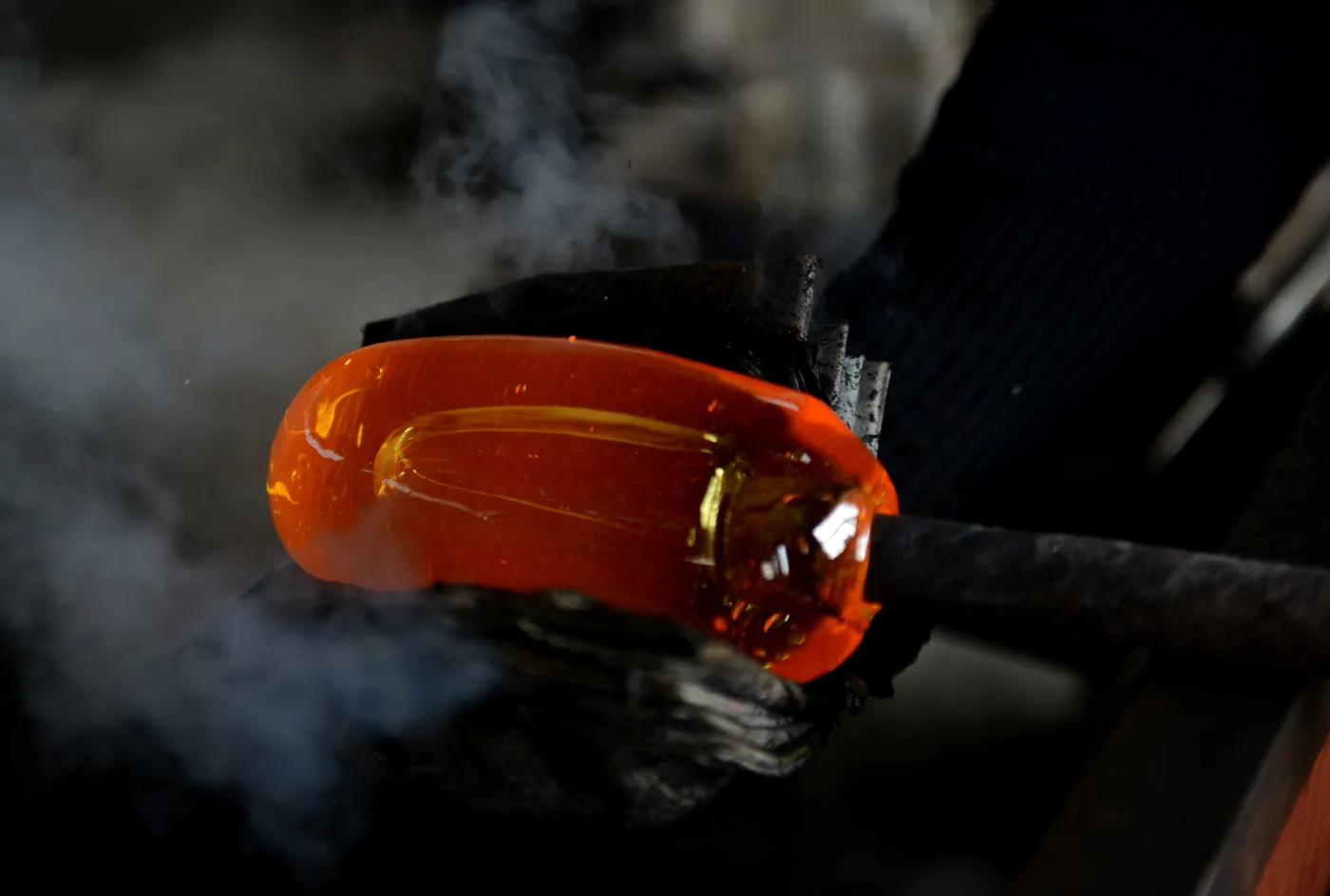
Choose fully hand-blown when the design accepts individual differences. Each piece is shaped by the blower, so no two are identical, and the walls come out thicker than in a molded shade (SIGA, 2026). It suits organic forms where a slight difference is part of the look, as on our fully hand-blown shades, and it spares you the mold fee and the mold lead time.
It is not that a mold cannot make these shapes. It is that hand-blown suits designs that tolerate variation, and those buyers do not need to pay for a mold they have no use for (SIGA, 2026).
How much does a mold cost, and when does it pay off?
A mold costs from several hundred to several thousand US dollars, depending mainly on the size of the shade. You pay it once, separately from the unit price, and the cost guide lists what else is paid separately (SIGA terms, 2026).
Budget the mold together with the sample fee, which is a separate charge. There is no fixed quantity at which a mold pays off. It depends on your requirements for error and shape (SIGA, 2026). A buyer who needs matching pieces needs the mold even at 20 pieces, and a buyer who accepts variation may never need one. A museum guide describes how glass molds are made and used (Corning Museum of Glass).
How do I judge a hand-blown shade before I order?
Each hand-blown piece differs slightly, so the sample you approve is the reference for the batch (SIGA, 2026). Look at the sample photos against your drawing, and tell us before you approve it if the difference is more than you can accept.
The hole for the fitting is drilled with a drill bit of the matching size, so give the opening size on your drawing (SIGA, 2026). Our ordering guide lists everything to send with a first inquiry.

For a hand-blown order, write the acceptance rule as "close to the approved sample" and add the largest difference you will accept. That is our judgment about how to avoid a dispute and not a standard, but it gives both sides one reference to measure against.
Who should not choose each process?
Do not choose fully hand-blown if your project needs a total error tighter than about 5 mm, or if every piece must look identical (SIGA workshop estimate, 2026). If you accept individual differences, you may not need a mold, and so you may not need to pay the mold fee.
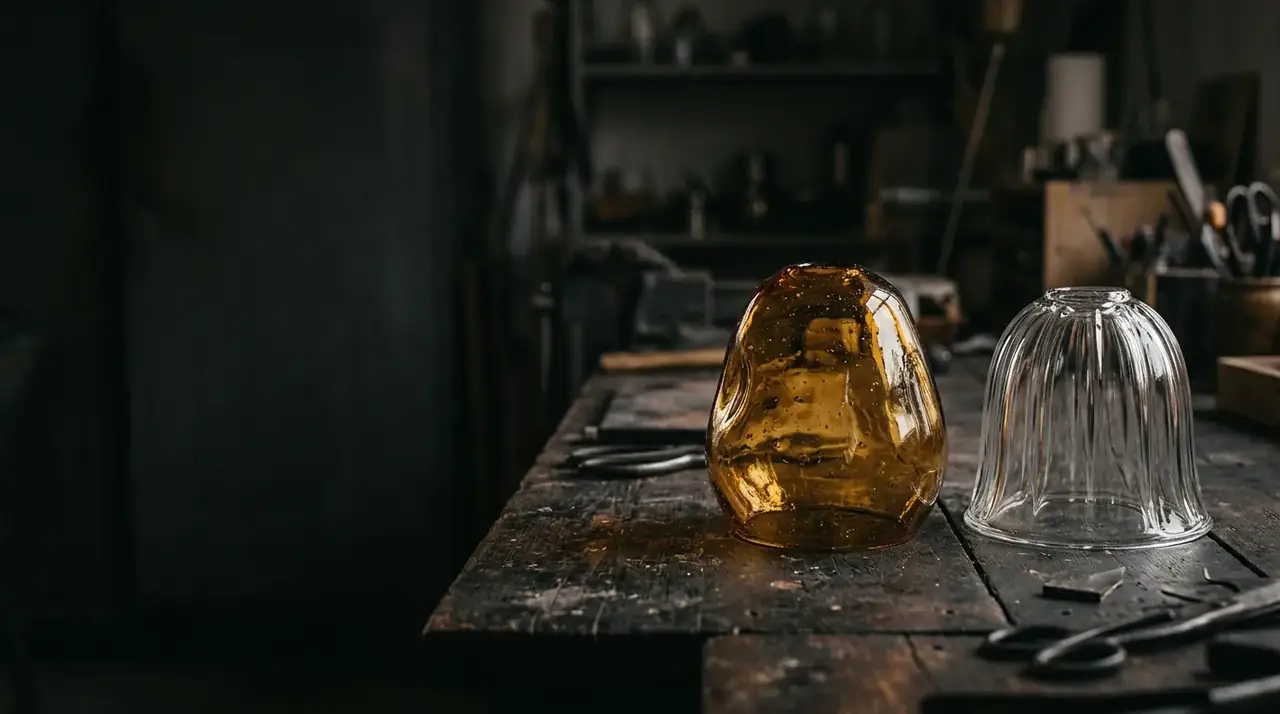
If you are unsure which side you are on, send the drawing before you decide: we advise on the process when we see the shape (SIGA, 2026). The illustration below shows the two kinds side by side, since we do not yet have a real photo of a hand-blown and a molded shade together.
Answer these questions before you write to us, and send the answers with your drawing.
| Question | If yes |
|---|---|
| Must every piece match in diameter and height within 1 to 2 mm? | Mold-blown |
| Can the project accept a total error of about 5 mm and a slightly different look on each piece? | Fully hand-blown |
| Do you want to avoid a one-time mold fee? | Fully hand-blown |
Sources and Further Reading
- Corning Museum of Glass: Mold Blowing. A museum guide to blowing glass into a mold to give it shape. Checked 2026-10-17.
- Corning Museum of Glass: Molds and Moldmaking. An overview of glass molds and how they are made and used. Checked 2026-10-17.
- The Metropolitan Museum of Art: Roman Mold-Blown Glass. An essay on mold-blown glass, including the uniform size and shape of plain wares. Checked 2026-10-17.
- Wikipedia: Glassblowing. A general background article on free blowing and blowing into a mold. Background source. Checked 2026-10-17.
Frequently Asked Questions
Can any shape be made in a mold?
Yes. Any shape can be made in a mold when you need every piece to match in shape and size. Fully hand-blown suits designs that accept individual differences. The choice is about repeatability and the mold fee, not about whether the shape is possible (SIGA, 2026).
How much does a mold cost?
A mold costs from several hundred to several thousand US dollars, depending mainly on the size of the shade. The fee excludes the sample fee, is paid once and is separate from the unit price. The cost guide gives the range and lists who pays for what, so you can budget the first order before you send a drawing (SIGA terms, 2026).
Are hand-blown shades thicker?
Yes. Hand-blown shades have thicker walls and look less uniform than molded ones, and each piece differs slightly. We do not publish a wall thickness figure, so judge the look and weight from the sample you approve, which is the reference for the batch (SIGA, 2026).
What is the minimum order?
Twenty pieces per design, for both processes. The same minimum applies, so a small run does not have to be hand-blown. The difference is the mold fee for molded shapes, which you pay once and which does not depend on order quantity (SIGA terms, 2026).
Send your drawing, quantity and tolerance, and we tell you which process fits. We reply within 12 hours.
Contact our team